

Intelligent Miner
Automatically optimize your fleet's mining profiles to maximize profit based on real-time market conditions
Commander Pro Required
Intelligent Miner is available exclusively on the Commander Pro plan. See Pricing for details.
Overview
Intelligent Miner is Commander's intelligent fleet optimization engine. It continuously analyzes market conditions - hashprice and power prices - alongside your site's operational constraints (including those from Ancillary Services participation) and fleet composition, and then determines the optimal mining profile for every machine in your fleet to maximize total profit.
Traditional mining firmware offers a binary choice: miners are either active at nameplate settings or sleep. With LuxOS, each miner can operate across multiple performance profiles, ranging from underclocked (more efficient) to overclocked (more hashrate). Intelligent Miner leverages this flexibility to dynamically adjust each miner's profile so your fleet is always operating at its most profitable configuration.
Why Intelligent Mining Matters
Mining profitability depends on two constantly changing variables: hashprice (the revenue per unit of compute) and power price (the cost of electricity). When hashprice drops or power prices spike, running every miner at full power may be unprofitable. Conversely, when conditions are favorable, leaving miners underclocked means leaving money on the table.
Rather than making binary on/off decisions, Intelligent Miner modulates each miner's production power target to find the sweet spot where fleet profit is maximized. An underclock that reduces hashrate also significantly improves efficiency, which can keep a miner profitable in conditions where it would otherwise need to be shut down entirely. Intelligent Miner automates this decision across your entire fleet, every optimization cycle.
How It Works
Intelligent Miner uses an optimization algorithm that evaluates every possible miner-profile combination across your fleet and selects the combination that maximizes total fleet profit while respecting your site's power constraints and operational stability penalties.
The process runs on a recurring cycle and follows these steps:
-
Gather market conditions: Intelligent Miner retrieves the current hashprice and spot power price for each site, along with any applicable cost adders (such as transmission and distribution charges, REP adders, etc). It also reads the site's minimum and maximum power load constraints.
-
Evaluate fleet composition: Intelligent Miner identifies every miner at the site along with its available LuxOS profiles (typically ranging from -6 to +2 relative to nameplate). Each profile has a known hashrate and power consumption.
-
Compute profit per profile: For every miner-profile combination, Intelligent Miner calculates the hourly profit: revenue (based on hashrate and hashprice) minus cost (based on power consumption and power price).
-
Optimize fleet-wide: Using all miner-profile profit calculations, the site's power constraints, and stability penalties (transition, overclock, and power-cycle costs), the optimizer selects exactly one profile per miner such that total fleet profit is maximized and total power consumption stays within the site's min/max load boundaries.
-
Apply decisions: The selected profiles are dispatched to the fleet via Commander Agents.
The algorithm finds a globally optimal solution — no other combination of profile assignments can achieve higher profit while satisfying the constraints and accounting for transition costs.
Using the Controls
The chart includes a download button to export the data and a fullscreen toggle for detailed analysis. Hovering over the curve shows the profit and power values at any point.
Intelligent Miner Page Layout
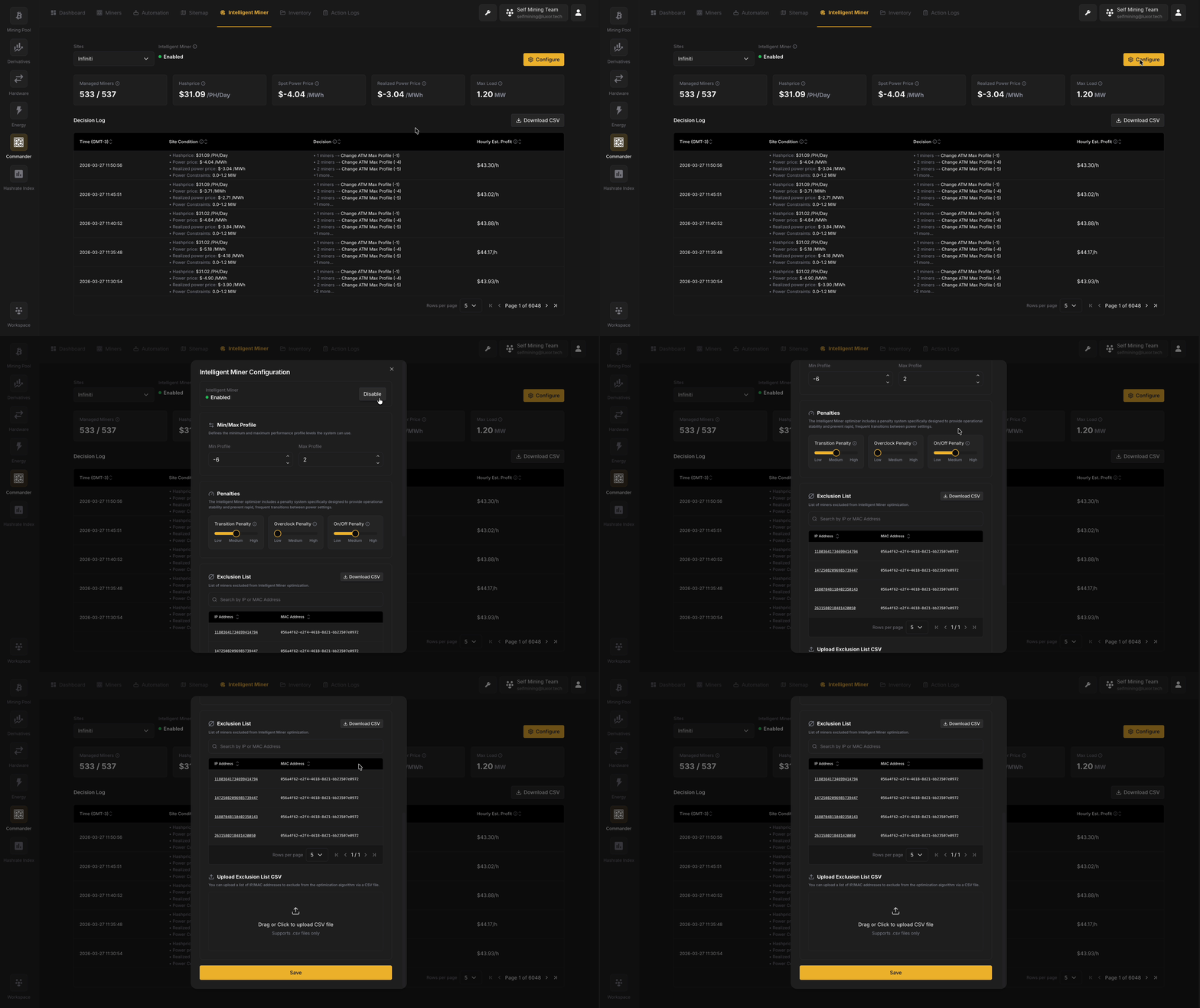
At the top of the Intelligent Miner page, four summary cards display the current market conditions and site parameters:
| Card | Description |
|---|---|
| Managed Miners | The number of miners enrolled in Intelligent Miner out of the total available at the site (e.g., 120/200) |
| Hashprice | The current hashprice in BTC/PH/day |
| Spot Power Price | The current spot electricity price in $/MWh |
| Max Load | The site's maximum power load constraint in MW |
Site Selector and Controls
Below the summary cards, a Site dropdown lets you select which site to view and manage. Next to it, an Enabled/Disabled toggle controls whether Intelligent Miner is actively optimizing the selected site. The Advanced Settings button opens configuration options for fine-tuning the optimizer's behavior.
Optimization History Table
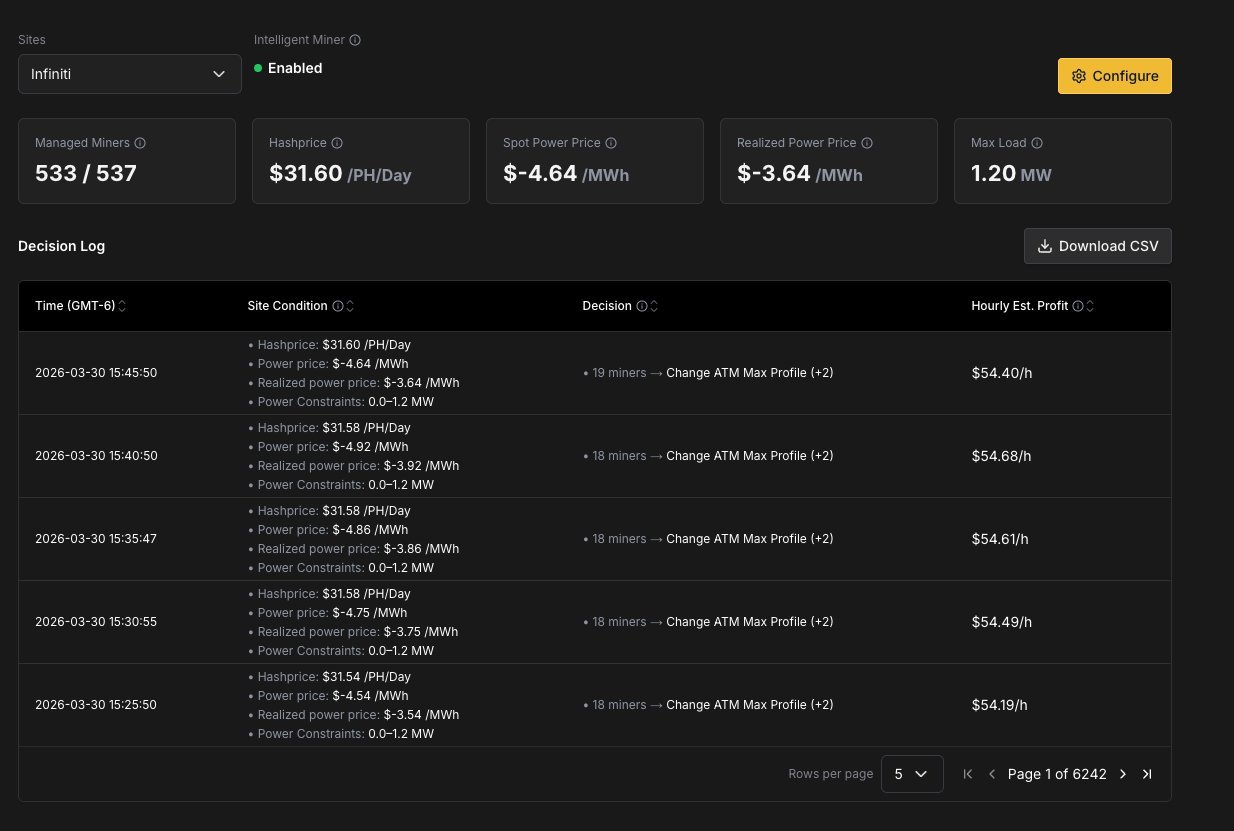
The main table on the Intelligent Miner page shows a log of optimization decisions, with the following columns:
| Column | Description |
|---|---|
| Time | The user who initiated the optimization cycle and the timestamp |
| Site Condition | The market inputs at the time of the decision: hashprice, power price, and power constraints (min–max load) |
| Decision | A summary of what the algorithm decided - how many miners were assigned to each profile change, and how many were put to sleep |
| Hourly Est. Profit | The estimated hourly profit resulting from this configuration |
Dispatch Curve
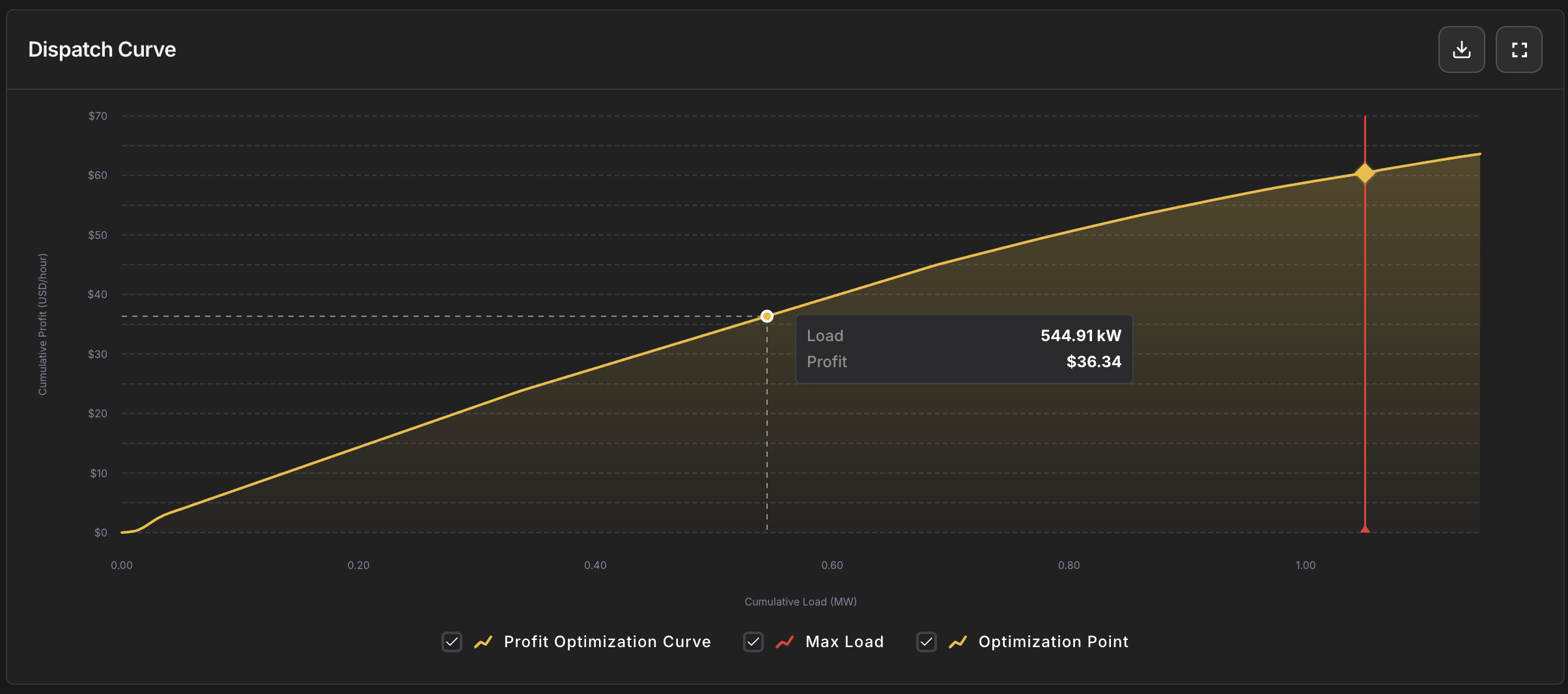
The Dispatch Curve is the core visualization on the Intelligent Miner page. It shows, for the currently selected site, how fleet profit scales with power consumption under current market conditions — giving you a complete picture of the economics of your mining fleet.
What the curve represents
The curve is built from marginal tranches — incremental power and profit steps between consecutive miner profile levels. Each tranche represents the additional profit gained (or lost) from adding a small increment of load. Moving from left to right along the X axis, tranches are ordered from the most economic to the least: the highest marginal profit per kW comes first.
Because the most profitable tranches are dispatched first, the slope of the curve (rise over run) generally decreases as you move right. Early tranches add significant profit per kW; later tranches add progressively less. When market conditions make some miner-profile steps unprofitable, the curve forms a decay region — a declining portion where adding more load reduces total profit.
The Optimization Point marks where Intelligent Miner has decided to operate the fleet. The portion of the curve to the right of the Optimization Point shows what would happen if more load were added. In most market conditions this means diminishing or negative returns, though when the site is power-constrained the curve may continue rising — indicating additional profit that could be captured if the power ceiling were raised.
Key elements
| Element | Description |
|---|---|
| Profit Optimization Curve | The yellow line. Plots cumulative fleet profit against cumulative fleet load, with marginal tranches ordered from most to least economic. |
| Optimization Point | The yellow diamond. Marks the fleet configuration selected by the optimizer to maximize profit under current market conditions, site constraints, and transition costs. This is the state Intelligent Miner dispatched to the fleet. |
| Max Load | The red vertical line. Represents the site's hard power ceiling, sourced from site settings and Energy contracts. Intelligent Miner will never dispatch a configuration that crosses this line. |
Hovering over any point on the curve reveals the cumulative load and cumulative profit at that position. You can download the curve data using the button in the top-right of the chart, or enter fullscreen mode for closer inspection.
Reading the curve
The shape of the curve tells you how Intelligent Miner is responding to current conditions:
- Unconstrained optimum: When the Optimization Point sits to the left of the Max Load line, the site has more power headroom than it economically needs. Intelligent Miner dispatches below Max Load because adding more load would not improve profit after accounting for market economics and operational costs. This is common when hashprice is low or power prices are elevated.
- Constrained optimum: When the Optimization Point sits at the Max Load line, the site is power-limited — Intelligent Miner would dispatch more load if the site allowed it. The curve beyond the Max Load line shows the profit that could be captured if the power ceiling were raised.
- Curtailment regime: When the curve peaks early and declines steeply, market conditions are unfavorable and the optimum load is well below the site's maximum. Intelligent Miner will curtail underperforming miners and run only the most efficient profiles — or, in extreme cases, put the fleet to sleep entirely.
How the Optimization Point is determined
The Optimization Point is determined by the optimization algorithm, which considers factors beyond the raw economics shown in the curve:
- Power constraints: min/max load limits
- Transition penalties: a cost applied to changing a miner's current profile, discouraging unnecessary state changes
- Overclock penalties: a cost for running miners above their default profile step
- Power-cycle penalties: a cost for turning miners on/off, preventing excessive cycling
Because of these penalties, the Optimization Point may sit slightly before or after the curve's peak. When penalties are low, the Optimization Point tends to align with the peak. When penalties are significant, the optimizer may keep miners active past the peak (to avoid cycling costs) or stop short of the peak (to avoid transition costs). The curve shows the raw economics; the Optimization Point reflects the optimizer's real decision including all operational costs.
Why the slope decreases
Intelligent Miner orders tranches by marginal profit per kW across the entire fleet, not by miner or by profile. That means the first tranche dispatched is always the single most profitable increment available — typically the first step of the most efficient miner model. Each subsequent tranche adds less marginal value.
This ordering produces the characteristic curve shape: steep rise at low load (high-margin tranches) and gradual flattening (diminishing returns). When energy prices are high enough to make some tranches unprofitable, the curve develops a decay region — a declining portion beyond the peak. With a mixed fleet of different miner models, you may see distinct tiers in the curve — for example, a steep section for efficient next-gen miners followed by a flatter section for less efficient older models.
This merit-order principle is what enables Constrained Optimal Dispatch. When a site must stay below a power ceiling (e.g., a transformer limit, a contracted demand cap, or an Ancillary Services commitment), the optimizer selects the best feasible configuration within that boundary — capturing the most profitable tranches first and leaving the least profitable ones undispatched.
The same logic applies in reverse: when a site has a minimum load obligation (for example, a contractual commitment to consume a certain amount of power), the optimizer selects the configuration that satisfies the minimum while losing as little profit as possible. Constrained Optimal Dispatch can mean maximizing profit or minimizing loss, depending on the site's constraints.
Advanced Settings
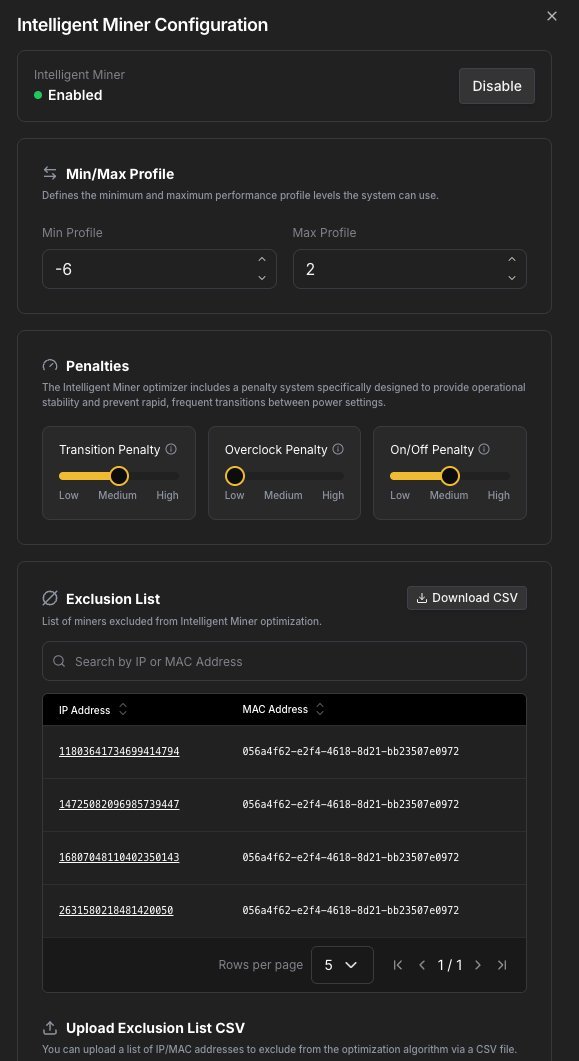
The Advanced Settings panel lets you fine-tune the optimizer's behavior, including penalty weights for transitions, overclocks, and power cycling. These settings control how aggressively Intelligent Miner responds to market changes.
Stability and Penalties
Intelligent Miner includes a built-in penalty system designed to promote operational stability. Rather than reacting to every minor market fluctuation, the system applies small economic penalties to profile changes, which creates a threshold that must be exceeded before a transition is worthwhile.
There are three types of penalties:
- Transition penalty: Applied to any profile that differs from the miner's current profile. This discourages unnecessary changes unless the economic benefit clearly justifies the switch.
- Overclock penalty: Applied cumulatively to overclock profiles (steps above nameplate). Higher overclock levels carry larger penalties, modeling the increased wear and reduced reliability at higher performance levels.
- Power cycle penalty: Applied when a miner transitions between offline and active states, discouraging rapid on/off cycling.
These penalties work together to ensure that only significant market movements trigger profile changes, while minor fluctuations are absorbed. The result is a fleet that responds to meaningful opportunities without the operational chaos of constant reconfiguration.
The Dispatch Curve shows raw economics (profit without penalties). The Optimization Point reflects the optimizer's actual decision including penalty costs. This is why the Optimization Point may not always sit at the peak of the curve — the optimizer accounts for transition costs that the curve does not display.
Prerequisites
To use Intelligent Miner, the following conditions must be met:
- Although Intelligent Miner supports any firmware OS that Luxor Commander supports, it is recommended that Miners run LuxOS firmware, as it supports a vast array of power configurations that Intelligent Miner can use to achieve a much higher profitability than with other traditional firmware OS.
- The site should have power constraints configured for best results. Power constraints available are those related to the Site (users can edit them from the
Sitestab in the Workspaces section) like Baseload Capacity and Max Capacity, and also those from the Energy Contracts (created from theContractstab in the Energy section).